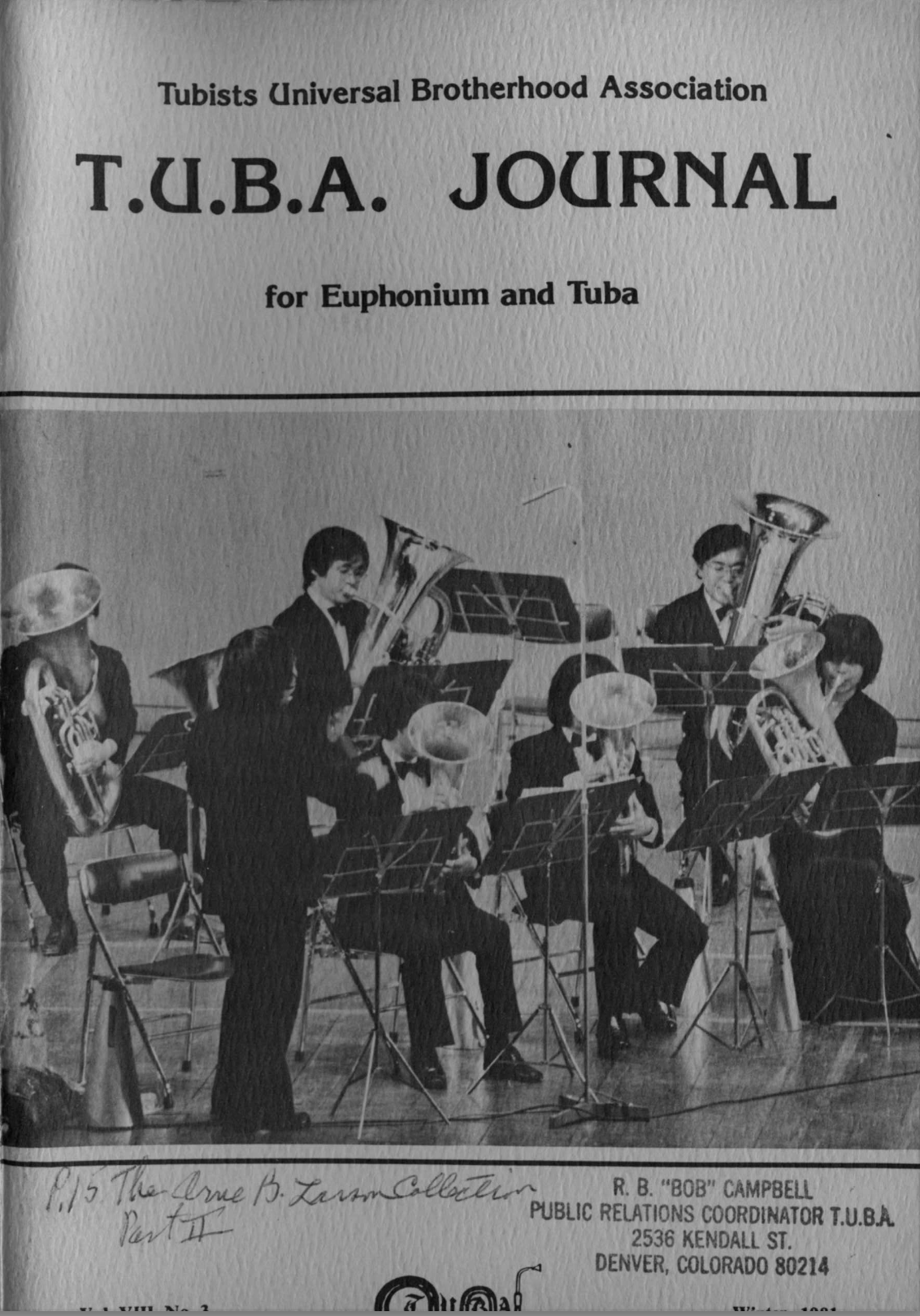
ITEA JOURNAL VOLUME 8:3 (Winter 1981)

23168
Editor: Steven Bryant
AD_4nXfno2Df4Ptvy-h3gAqEJEf-gWhyjnADItEtCkUCIZegGiD6XGmFIL0YVkzp-Kv4MYwltH7G_KkMWK4cdMvD_FETpSXrhxMWZqg-IHe6m7UEGaMRKR5f_fuvS1tLiVMkcNEPH7G9AQkeyIloMWbcWmi2AVX44JV8Idw
TUBANEWS
TUBIST WINS PASADENA SYMPHONY COMPETITION On October 4th and 5th, 1980, the Pasadena Symphony Orchestra held a Solo competition for brass players. Young musicians...
AD_4nXdMDtkgNGsLAzZiopKv82tsIy6dc1OMxdKfgimJkjbYQlTzX6wavtrWsGeVPU8beVIhxjVqbLMSeNgLb-l-LhRvgncBTyP9JD10z_I07a7TjoRgrWbyohg8f1r3PaaRXVjwkBU57gkeyHzQhqg-hgqsiONivYw4RjQ9d
THE EUPHONIUM AND TUBA IN JAPAN - Toru Miura
In Japan, at present, there are twenty professional orchestras (full-time), four professional bands, many recreational bands, and the Ground, the Maritime, and the Air...
AD_4nXfFdmw1XtI0PBkeM264U7wSbA3qy-qzvcErjLDXTqDCGKJYYyVzM5Cmv9U4OBYKNOwLVdxeVGnJDE0K21nKCC2UslaQQKyIaews_CaUd6AUzlnuTmkqqHrkp-RVj4_foCEr3MYvAgkeyRWYGA3di-4_hDc625B5V2WgL
THE ARNE B. LARSON COLLECTION PART II - Mary Petersen
Part I found HERE In meeting requirements for a Master of Music degree in the History of Musical Instruments at the University of South...
08N03Cover
SOME THOUGHTS ON POSTURE AND HOLDING THE EUPHONIUM - M. Dee Stewart, Indiana University (formerly of the Philadelphia Orchestra and the Curtis Institute of Music)
Euphonium players have long been aware of the difficulties in obtaining both good posture and a comfortable playing position. If the instrument is held...
08N03Cover
SECOND NATIONAL TUBA-EUPHONIUM SYMPOSIUM-WORKSHOP (SNTESW) A WRAP-UP
Continued from Fall issue RECITAL REVIEWS RECITAL – Reviewed by Charles A. Schulz, Memphis State University RICHARD NAHATZKI, TUBALARRY CAMPBELL, EUPHONIUM Two solo recitals...
08N03Cover
IN MEMORIAM
IRA D. LEE 1925-1980 – Robert Vagner Ira D. Lee graduated from the University of Colorado in 1947 and taught for several years in...
08N03Cover
AVANT-GARDE EFFECTS FOR TUBA: MUSIC OR NOISE? - Dr. David M. Randolph, University of Georgia
Much of the avant-garde literature for wind instruments calls upon the performer to use rather unusual sound production methods, with the resultant effects as...
AD_4nXc_T5qzKUdwLnHh8eG-ntgt4SJZkrXzzoCifpUOrAoq4bPwmkcSpdkegNCrFCgktVVdCwBWr9gTitYSPul09kPW0HztLZ-PwYRO_kazSPkjeXTbHuUJCBGbJ1f5m0vRmgMEQrR_keysPbDyciFxKg0Mv_SrVTYSEKW
A YOUNG TUBIST’S GUIDE TO THE BREATH - Donald C. Little, North Texas State University
Quite a while ago I promised Cherry Beauregard that I would contribute an article to the “Tuba Pedagogy” section of our Journal. Now that...
AD_4nXcpdJygut6qBu8TmmShTm3hUw4R9u6pusRd1W7GR4YfjM6nQu6tdsK5IKsHmfXUn1oMzs6tu2ZpMH1Bmcp5Z2Pu0n-NG5zMPsyBAOFxai0YYCoOdifYUQgp6UPkfTyrBMPpmL_prQkeyZWlQJgX7U-x4sYwx1LDvU9Gd
A PICTORIAL HISTORY OF THE TUBA AND ITS PREDECESSORS - Robert E. Eliason
(a continuing series) Curator of Musical Instruments – Henry Ford MuseumT.U.B.A. Coordinator – Tuba/Euphonium History Early designers of bass valve instruments had only ophicleides...

RATING SYSTEM for the ITEA Standard Repertoire List

Designed and created by Dr. Mark S. Cox OVERVIEW “Range” (40 points) is the most basic and critical element in choosing repertoire. Thus, it carries the most weight. The difficulty and types of intervals is the next factor in determining how challenging a work will be for a student. A soloist’s ability to navigate these intervals (what the committee termed “Dexterity” [30 points]) has a profound impact on how successful the performance will be. “Rhythm and Tempo” is self-explanatory and carries a numeric value of 20 points, realizing that there is often room for variation in tempo, depending on interpretation. Finally, “Miscellaneous” (10 points) includes items that are found in more advanced works that create additional challenges. TUBA RANGE (40 POINTS MAXIMUM) The basic tuba range (used consistently in early and intermediate works) extends from low B-flat to D in the staff. Within this basic range, the highest and lowest notes are determined and each half-step within the range receives one (1) point. Thus, a piece utilizing a range of a major third (B-flat to D, e.g.) would receive a number rating of 4. If the range of a work encompassed an octave, then it would receive a rating of 12. As would be expected, as range is extended, the level of difficulty increases. High range is more difficult to master than low range for most students, and the numerical values reflect this. Whenever a solo goes below or above the basic range as defined above, the starting numerical value is 16. Points are then added to this default number according to the chart. For example, a work that goes up to a D above middle C would receive 4 extra points. The total for the range would be 20 (16+4=20). A work that goes down to a low F would receive 6 extra points. The total would be 22 (16+6=22). If the range extends above and below the “basic range,” both values are added to the 16 default points. For example, a work with a range of low F to B-flat below middle C would receive 25 points (16+6+3 = 25). If the total surpasses the maximum, it automatically defaults to 40. EUPHONIUM RANGE (40 POINTS MAXIMUM) Points for range are more evenly distributed, although the low range is weighted somewhat more heavily than the high range. The basic range extends from B-flat to D above middle C. As above, when pieces go higher than the basic range, points are added according to the chart to the default number of 16. Pieces that extend lower than the basic range use either the “A” or “B” section of the chart, depending on whether the work requires four valves or not. For example a solo with the range of C below the staff to G above middle C would total 29 points (16 [basic] + 9 [low “B “ chart] + 4 [high chart] = 29). If the combined elements, added together, surpasses the maximum, the total automatically defaults to 40

DEXTERITY, RHYTHM AND TEMPO, MISCELLANEOUS
These become necessarily more subjective. The characteristics and point values are the same for both instruments.
DEXTERITY (30 POINTS MAXIMUM) The most challenging interval (taking into consideration frequency and context) is used as the basis for awarding points. For example, if a piece contains primarily major thirds with one perfect fifth, the major third would be used as the primary interval (4 points). Additional points may be added for pieces that require medium or advanced dexterity in moving from note to note. Tempo, rhythms, and the composer’s style and writing all have the potential to affect this. RHYTHM AND TEMPO (20 POINTS MAXIMUM) In most (although not all) solos, rhythms can be narrowed down to a few that most consistently make up the fabric of the piece. The ratings are determined by choosing the two rhythmic elements that most characterize the piece. Easiest works will be characterized by the type of note, while more advanced pieces will more often be defined by rhythmic concepts (syncopation, jazz, e.g.). Additional points for medium or fast tempi are added to reach the final total. A beginner solo might use only quarter and half notes. If the tempo was slow, total points would be 3 (1+2=3). A more advanced solo might look like this: 32nd notes, syncopation, and fast tempo adds up to 16 (7 + 3 + 6 = 16). Note that points are capped at 20. If the individual elements added together surpass this, the total automatically defaults to 20. MISCELLANEOUS (10 POINTS MAXIMUM) This includes compositional techniques and details that increase the difficulty of the work. Pick as many as are applicable. Miscellaneous points are capped at 10. If the individual elements surpass this, the total automatically defaults to 10. These are advanced techniques; most beginner and intermediate pieces will not contain anything from this list. OPTIONAL NOTE(S) RATING Composers and/or publishers at times add “optional ” notes for tuba and euphonium players, usually up or down an octave. This can add a more bravura element to the music, or, conversely, provides an easier alternative to a challenging passage. When this occurs, the rating inclusive of the optional notes can be found under the header “Optional.” The ratings for the individual categories in which the notes occur are represented by the lower of the two numbers.